
Cheap MVP Cost: Technical Debt Explained
The cheap mvp cost is not just the quote. Learn how technical debt creates rebuilds, delays, and security problems after launch.
Build My App Fast · Aug 21, 2026 · 14 min read
The cheap mvp cost is not the number on the first quote. It is the quote plus the cost of fixing brittle architecture, missing security, unreliable payments, unclear data models, and code nobody wants to touch later. A cheap MVP can be a smart move if the scope is intentionally small. It becomes expensive when “cheap” means “built without production standards.”
This matters because founders often compare MVP options as if all delivered apps are equivalent. A $1,000 prototype, a $5,000 fixed-scope app, a no-code build, a freelancer project, and a vibe-coded repo may all look similar in a demo. The difference shows up when real users sign up, payment webhooks fail, permissions leak data, or the next developer says the fastest path is a rebuild.
At Build My App Fast, we keep MVPs small on purpose, but we do not treat production basics as optional. Our standard stack is Next.js, React, Supabase, Stripe, Tailwind, Resend, and Vercel. The goal is not to over-engineer the first version. The goal is to avoid the avoidable debt that blocks launch, learning, or iteration.
Cheap MVP Cost: What You Are Actually Buying

A cheap MVP is not automatically bad. The problem is ambiguity.
When a quote is low, you need to know what was removed to make it low. Sometimes the answer is good: fewer features, simpler workflows, one user role, one integration, no custom admin panel. That is healthy MVP scoping.
Sometimes the answer is dangerous: no authentication review, no database access rules, no error handling, no webhook verification, no deployment pipeline, no usable component structure, no ownership of the code, or no plan for handoff.
Those two versions can have the same price and a similar-looking demo. They have very different futures.
A real MVP should help you answer a business question. Can users understand the product? Will they pay? Does the workflow solve the painful part? Can you support the first customers without duct tape? If the app cannot safely be used by real users, it is closer to a prototype than an MVP. If you are still deciding which you need, our guide on MVP vs prototype is a useful starting point.
The true cheap mvp cost includes:
- The initial build
- Fixes needed before users can safely use it
- Rework needed to add the next obvious feature
- Lost time while developers reverse-engineer the code
- Revenue lost from broken checkout, onboarding, or emails
- Security risk from rushed permissions and secrets handling
- Opportunity cost from delaying validation
The cheapest version is not the smallest invoice. It is the smallest responsible path to learning from real usage.
The Difference Between Good Constraints and Technical Debt
Founders should cut scope aggressively. That is not the same as cutting corners.
Good constraints sound like this:
- “We only need email login for version one.”
- “We can use Stripe Checkout instead of a custom billing UI.”
- “We do not need team accounts yet.”
- “The admin view can be a simple protected page.”
- “We will support one core workflow, not five.”
Technical debt sounds like this:
- “Anyone can read any row in the database, but we will fix it later.”
- “Payments work locally, but webhooks are not deployed.”
- “The app only works if the founder manually updates records.”
- “There is no loading, empty, or error state.”
- “Environment variables are copied in random places.”
- “The AI tool generated code, but nobody understands the data flow.”
The first group is product discipline. The second group is deferred engineering.
Technical debt is not always bad. Every startup accepts some debt to move faster. The key question is whether the debt is visible, intentional, and cheap to repay. Hidden debt is what hurts. It sits under the demo and waits until the first real customer, investor diligence, or developer handoff.
Where Cheap MVPs Usually Accumulate Debt
The same weak spots show up repeatedly. They are not glamorous, but they determine whether an MVP survives contact with users.
| Area | Cheap shortcut | What breaks later | Better MVP approach |
|---|---|---|---|
| Authentication | Basic login pasted together without access rules | Users can access the wrong data or sessions behave unpredictably | Use a standard auth provider and define role/data boundaries early |
| Database | Tables created around screens instead of business entities | Every new feature requires messy migrations or duplicate data | Model core entities first: users, accounts, orders, projects, permissions |
| Payments | Checkout page works, but webhooks are ignored | Paid users are not provisioned correctly; cancellations do not sync | Use Stripe’s documented checkout and webhook flow from the start |
| Emails | Transactional emails sent from a personal account or ignored | Users miss invites, resets, receipts, or onboarding steps | Use a transactional service like Resend and centralize templates |
| UI | Demo-only screens with no states | Users get stuck when data is missing, slow, or invalid | Build basic loading, empty, error, and success states |
| Deployment | App runs locally only | Launch takes days of emergency configuration | Deploy early to Vercel and test production environment variables |
| Code structure | One giant file or generated spaghetti | Every change creates regressions | Keep components, server actions/API routes, and database logic separated |
| Ownership | Founder receives a demo, not a repo | Switching developers becomes difficult | Make code ownership and handoff explicit before work starts |
None of these require enterprise engineering. They require experienced defaults.
For example, Supabase can be excellent for an MVP, but only if authentication and data access are handled deliberately. Supabase’s own authentication documentation is a good reference for how much is involved beyond “add login.” Stripe is similar: collecting payment is only part of the job. Stripe’s checkout documentation makes clear that sessions, fulfillment, and webhooks all matter.
A cheap build that skips these areas may still look finished. It just is not ready to be depended on.
The Rebuild Trap
The most expensive cheap MVP is the one that cannot be extended.
This usually happens in three stages.
First, the founder gets a fast demo. It has a homepage, login, dashboard, and a couple of forms. The interface looks good enough to show. Everyone feels momentum.
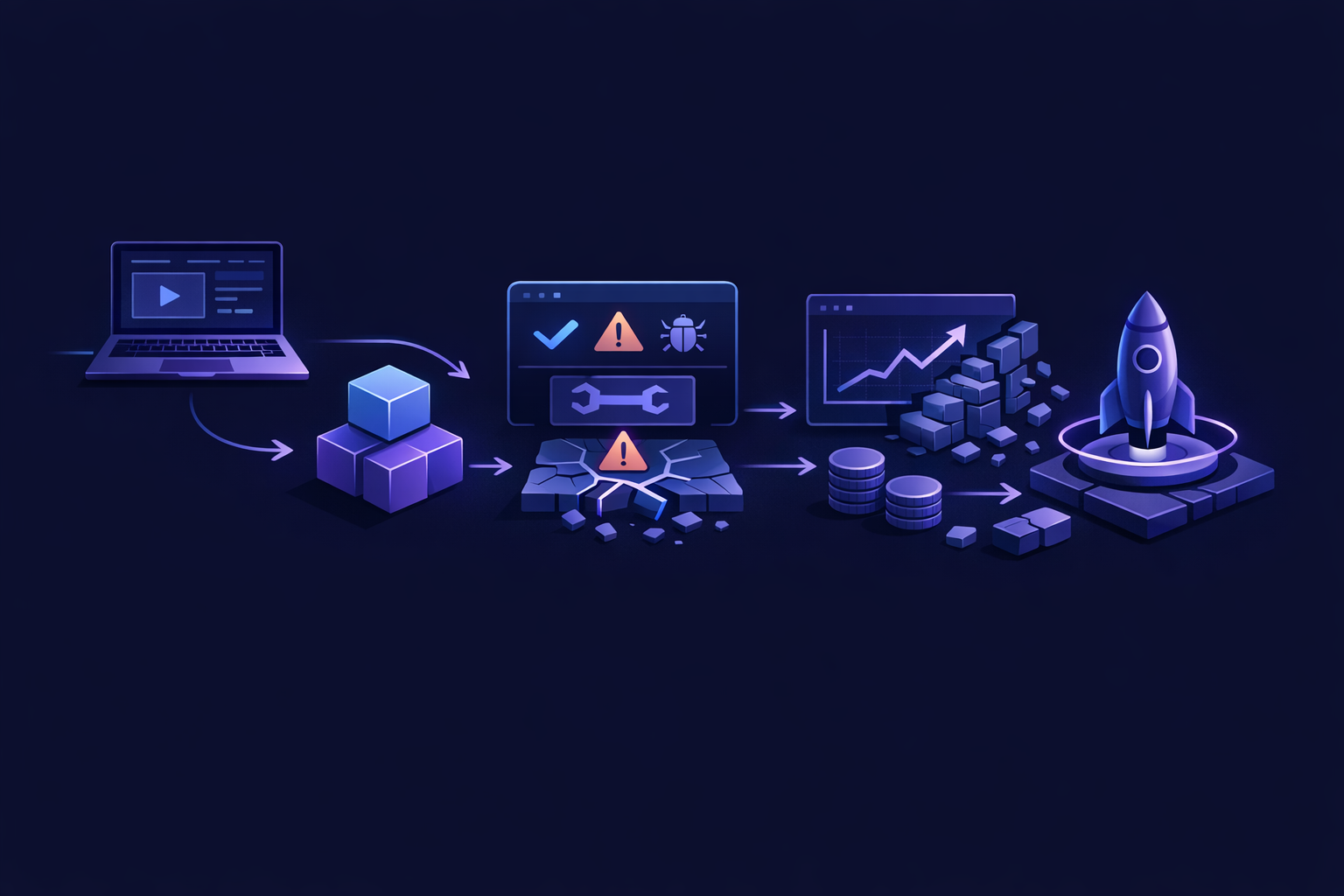
Second, the founder asks for the next practical feature: billing, team invites, admin controls, search, AI processing, file uploads, or a customer-specific dashboard. The developer slows down. The database does not support the workflow. The generated code has duplicated logic. Permissions are unclear. Adding one feature affects five unrelated screens.
Third, a more experienced engineer reviews the repo and says the sentence founders hate: “We can patch it, but a rebuild would be cleaner.”
That is the rebuild trap. The first build was not really a foundation. It was a screenshot that happened to run.
This is especially common with vibe-coded projects where the founder or a junior operator gets far enough to create a convincing UI, but not far enough to build durable product behavior. We covered this pattern in more depth in Vibe Coding Technical Debt: The Bill Comes Due.
The fix is not to avoid speed. The fix is to combine speed with a small number of non-negotiables:
- A clear data model
- Authentication and authorization that match the product
- Production deployment early, not at the end
- Payment and email flows tested in realistic conditions
- A repo a second engineer can understand
- A feature scope small enough to finish properly
Fast is good. Fragile is not.
How to Tell If a Low Quote Is Actually Expensive
A low quote can be legitimate if the scope is narrow and the delivery process is clear. It is risky when the quote avoids specifics.
Ask these questions before you accept a cheap MVP proposal:
- What exact features are included and excluded?
- Will I own the full codebase and deployment accounts?
- What stack are you using?
- Will the app be deployed before final payment?
- How are authentication, permissions, and database security handled?
- Are Stripe webhooks included if payments are included?
- What happens if the production build behaves differently from local development?
- Will the code be structured so another developer can continue it?
- What third-party services are required, and who owns those accounts?
- Is this a prototype, an MVP, or a launchable app?
If the answers are vague, the price is not the only thing that is cheap.
This is also why fixed-price work needs a tight scope. A fixed price without scope discipline becomes a fight. Hourly work without budget discipline becomes drift. We compare that tradeoff in Fixed Price vs Hourly Development, but the short version is simple: fixed price works best when everyone agrees what “done” means.
What a Responsible Low-Cost MVP Looks Like
A responsible MVP is not packed with features. It is narrow, usable, and built on a foundation that can survive the next decision.
For many founders, that means:
- One primary user type
- One core workflow
- One database-backed dashboard
- Authentication that protects user data
- A production deployment URL
- Basic transactional email if the workflow needs it
- Stripe only if payment is part of validation
- Enough admin visibility to support early users
- Clean handoff with full code ownership
That is not a full product. It is a real app designed to answer the next business question.
Our own tiers are structured around that idea:
- $1,000 "Proof of concept" — proof of concept, delivered in 2–4 days
- $5,000 "Real app" — full app with logins and a database, delivered in 4–6 days
- $10,000 "Launchable MVP" — advanced MVP with subscriptions, integrations, or AI features, delivered in 7–10 days
Those tiers are not interchangeable. If you need to test whether a workflow makes sense, a proof of concept may be enough. If users need accounts and saved data, you probably need a real app. If you need subscriptions, integrations, or AI features that users will rely on, you are in launchable MVP territory.
The important part is matching the build to the risk. Do not pay for advanced infrastructure before you need it. Do not pretend a demo is a launchable product when users, payments, or sensitive data are involved.
For a broader cost breakdown, see MVP Cost 2026: Real Breakdown.
A Practical Technical Debt Checklist for Founders
You do not need to become an engineer to spot risk. You need a short checklist and the willingness to ask direct questions.
Before calling a cheap MVP “done,” confirm:
- The app is deployed to a production URL, not just running locally.
- You own the GitHub repository or equivalent source control.
- Environment variables and API keys are not hardcoded.
- Authentication is connected to real user data.
- Users cannot access records that do not belong to them.
- The database has clear tables for the main business objects.
- Critical forms validate input and show errors.
- Payment flows include success, failure, and webhook handling if Stripe is used.
- Emails come from a transactional email service, not a personal inbox.
- There is a simple README or handoff note explaining setup and deployment.
- The app has been tested on the deployed environment.
- The next planned feature would not require throwing away the whole data model.
If several of these are missing, you may still have something useful for demos or user interviews. Just be honest about what it is. Calling it production-ready too early is how cheap MVPs become expensive.
When Cheap Is the Right Move
There are situations where the cheapest possible version is exactly right.
If you are testing demand, you may not need software at all. A landing page, manual concierge workflow, clickable prototype, or sales calls may answer the question faster. Building too early is its own cost.
If you need to communicate an idea to a stakeholder, a proof of concept may be enough. It can show the flow, clarify the product, and help you decide whether to continue.
If you already have users waiting and the product requires saved data, logins, and repeat usage, then cheap should mean “narrow,” not “unfinished.” You can cut scope, not safety.
A good MVP budget is connected to the decision you need to make next:
- Are we testing whether people understand the concept?
- Are we testing whether users complete the workflow?
- Are we testing whether people will pay?
- Are we testing whether an integration or AI feature is reliable enough?
- Are we trying to onboard the first real customers?
Different questions justify different builds. The mistake is buying a prototype when the business needs a real app, or buying a complex MVP when the business only needs a demand test.
How to Reduce Cheap MVP Cost Without Creating Debt
The safest way to reduce cost is to reduce uncertainty before development starts.
Write down the core workflow in plain English. Define the user roles. Decide what data must be saved. List the screens. Mark which features are required for version one and which can wait. If payments are needed, decide whether you need one-time checkout, subscriptions, trials, coupons, invoices, or customer portals. Each billing choice affects scope.
Then remove anything that does not support the first business question.
Common cuts that reduce cost safely:
- Delay team accounts
- Delay custom analytics
- Use Stripe Checkout instead of custom payment screens
- Use a simple admin table instead of a full internal tool
- Start with email/password or magic-link login instead of many auth providers
- Support one integration before adding a marketplace of integrations
- Use a clean Tailwind component system instead of custom animation-heavy UI
- Keep AI features focused on one output, not an open-ended assistant
Common cuts that create debt:
- Skip access control
- Skip production deployment
- Skip payment webhooks
- Skip database planning
- Skip error states
- Skip code handoff
- Skip ownership terms
That distinction is the whole game. Cut features. Do not cut foundations.
FAQ
Is a cheap MVP always a bad idea?
No. A cheap MVP is a good idea when the scope is intentionally small and the build still follows production basics. It is risky when the low price comes from skipping authentication, database structure, deployment, ownership, or payment reliability.
What is the biggest hidden cheap mvp cost?
The biggest hidden cost is usually rework. If the MVP cannot support the next feature or a real user workflow, you may pay again to rebuild the same product on a better foundation.
Should I use no-code or AI tools to lower MVP cost?
Sometimes. No-code and AI tools can be useful for prototypes, internal workflows, and early validation. They become risky when founders assume a generated demo is the same as a production-ready app. If you use AI tools, have an experienced engineer review security, data access, and architecture before real users rely on it.
How much should I build before testing demand?
As little as possible. If a landing page, sales calls, or a manual workflow can answer the demand question, start there. Build software when you need users to interact with the product, save data, pay, or repeat the workflow.
Bottom Line
The true cheap mvp cost is the cost of getting to reliable learning. Sometimes that is a small proof of concept. Sometimes it is a real app with logins and a database. Sometimes it is a launchable MVP with subscriptions, integrations, or AI features.
What you want to avoid is paying for something that looks finished but cannot be used, extended, or trusted. A good MVP is small by design. A bad cheap MVP is small because the important engineering was never done.
If you want a fixed-price MVP with a clear scope, real production stack, full code ownership, and working software before final payment, apply here.