Customer Interviews to Features: Founder Guide
Convert customer interviews to features with a practical workflow for prioritizing MVP scope and writing build-ready product requirements.
Build My App Fast · Sep 29, 2026 · 11 min read
The practical way to move from customer interviews to features is to treat every interview as evidence, not instruction. Extract the painful jobs customers are already trying to complete, identify repeated blockers, turn those blockers into user stories, and ship only the features required to prove the core product promise. The goal is not to build everything customers mention. It is to build the smallest production-ready path that solves a real workflow well enough to charge, learn, and iterate.
Founders often come to us with interview notes, call transcripts, survey answers, and a long list of feature ideas. That is useful raw material, but it is not an MVP scope yet. A customer saying they want dashboards, reminders, exports, AI, mobile, team seats, and payments does not mean all of those belong in the first build.
The work is translation: messy language into product decisions, product decisions into screens, screens into data, data into secure production code.
Why interview notes are not product requirements
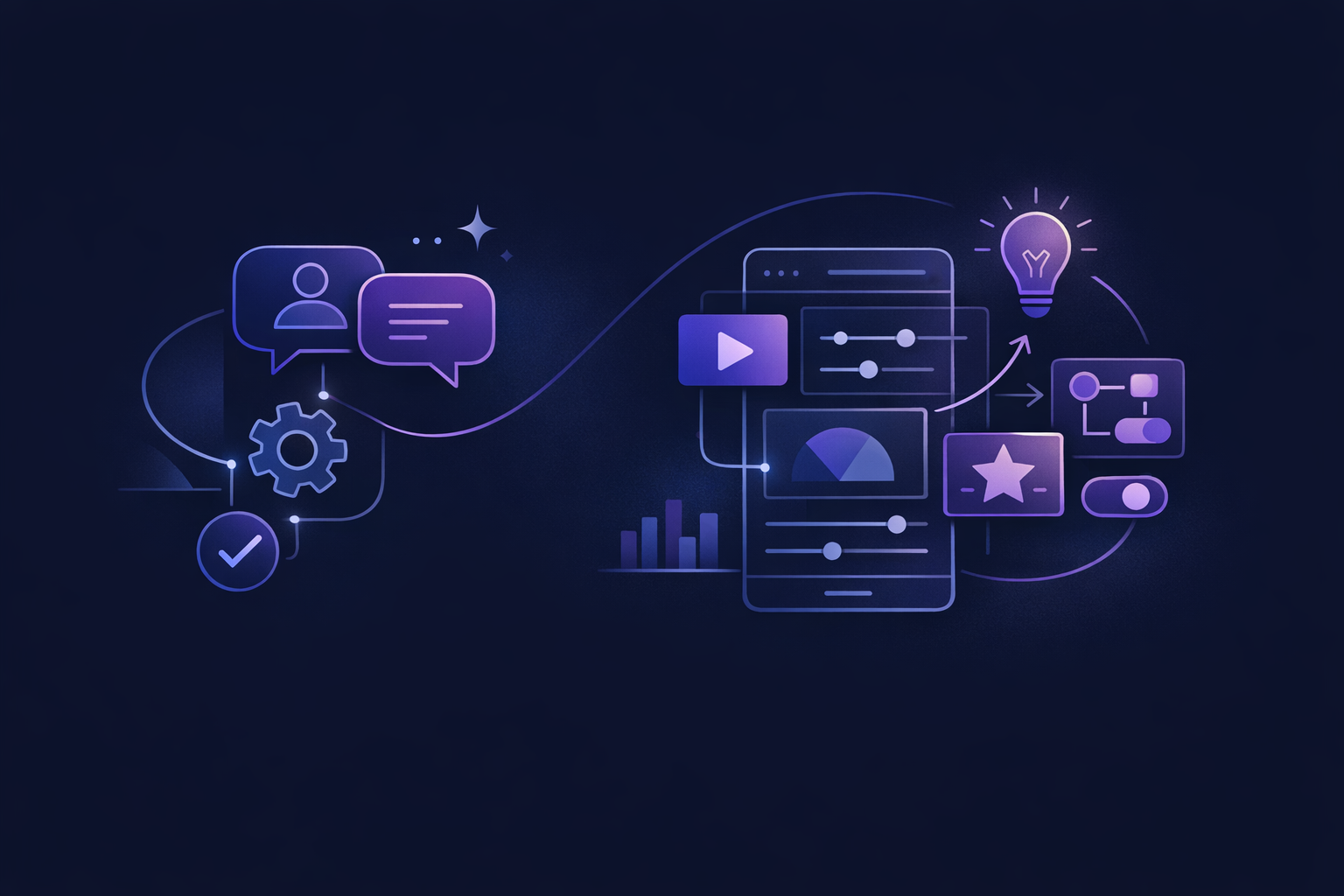
Customer interviews are excellent for learning about context, pain, urgency, and buying behavior. They are weak when used as direct feature requests.
A good interview tells you what the customer is trying to get done, what breaks today, what workaround they tolerate, and what consequence they face when the process fails. That is different from asking them to design your software.
Nielsen Norman Group has a useful overview of how user interviews work: interviews are qualitative research, not statistically perfect prediction. The founder’s job is to notice patterns and make product tradeoffs.
This matters because customers describe symptoms in the language of their current tools. If they say they need spreadsheet export, the real need might be reporting, compliance, approvals, backup, or sending data to a manager. If they say they need AI, the real need might be faster drafting, better search, or fewer repetitive clicks.
Before writing a feature list, rewrite the interview notes into problem statements.
Customer interviews to features: the translation pipeline
Use this pipeline after every interview batch:
- Pull out the exact workflow the customer described.
- Name the trigger that starts the workflow.
- Identify where the workflow slows down, fails, or creates risk.
- Capture the workaround they use today.
- Decide what product outcome would remove the pain.
- Translate that outcome into a feature candidate.
- Cut anything that does not support the launch promise.
That last step is where founders usually struggle. Interviews create empathy, and empathy creates scope creep. But an MVP is not a thank-you note to every interviewee. It is a focused test of a product thesis.
If you are still unsure whether the pain is real, do not jump into a full build. Start with a demand test. We wrote about that in How to Validate a Startup Idea Before You Build.
A simple interview-to-feature table
Here is a practical table you can use when reviewing notes. It keeps the team from copying customer phrases directly into the roadmap.
| Interview signal | What it may mean | Feature candidate | Question before building |
|---|---|---|---|
| They manually copy data between tools | Existing workflow has duplicate effort | Import, sync, or structured data entry | Which data must exist inside the app on day one? |
| They ask for reminders | The workflow depends on timing or follow-up | Email notification, task queue, or status change | What event should trigger the reminder? |
| They mention approvals | More than one role is involved | Role-based permissions or approval state | Who can approve, reject, or edit? |
| They want a dashboard | They need visibility into progress or outcomes | Summary page, filters, or report view | What decision does the dashboard help them make? |
| They request AI | They want speed, synthesis, or less manual writing | AI draft, classification, or search | What input, output, and review step are required? |
| They ask about billing | There may be purchase intent | Stripe checkout or subscription gate | What plan should unlock which capability? |
The table does not decide for you. It slows you down enough to ask the right product and engineering questions.
Prioritize by pain, proof, and build impact
Do not prioritize features by enthusiasm alone. Prioritize by evidence.
A feature is a strong MVP candidate when it meets these conditions:
- It maps to a painful workflow mentioned by more than one serious prospect or strongly validated by a buyer.
- It is required to deliver the main product promise.
- It creates a visible before-and-after improvement for the user.
- It can be explained in a short onboarding flow.
- It does not require a large hidden admin operation behind the scenes.
- It can be built securely with the current app architecture.
- It gives you useful learning after launch.
A feature is a weak MVP candidate when it is mostly cosmetic, supports an edge case, depends on customers you do not have yet, or exists because a competitor has it.
This is where a hard scope framework helps. Our MVP Features: The 3-Feature Rule explains how to constrain the first version without making it useless.
Turn pains into user stories, then acceptance criteria
Once you know which problems matter, write them in build-ready form.
A weak feature note looks like this:
Add reminders.
A build-ready version looks like this:
As a signed-in account owner, I want to receive an email reminder when an open request has not been completed, so I can follow up before it becomes late.
Then add acceptance criteria:
- A request can have an open, completed, or archived state.
- Only signed-in users who own the request can see it.
- A reminder is sent when the request matches the selected condition.
- The email includes the request title and a link back to the app.
- Users can turn reminders off for a request.
Now engineering can reason about database fields, authentication, background jobs, email sending, and edge cases. That is the difference between a feature idea and a production requirement.
For founders, this is also the fastest path to a useful handoff. If you need a structure, start with our MVP Spec: How to Prevent Misbuilds.
Map every feature to product surfaces
A feature is rarely one screen. Even a simple feature can affect the database, permissions, emails, payments, and empty states.
For each feature, define:
- The user-facing screen where the action happens.
- The database records needed to store it.
- The permission rules for who can create, view, edit, or delete it.
- The success state after the action completes.
- The error state when something fails.
- The notification, if the user needs confirmation or follow-up.
- The admin view, if support or operations must intervene.
- The analytics or event you need to learn from usage.
This is where production experience matters. In a Next.js, React, Supabase, Stripe, Tailwind, Resend, and Vercel stack, the visible button is often the smallest part. The real work is making sure auth, database access, billing state, emails, and deployment behavior are reliable.
For example, a customer may say they need team access. In product terms, that could mean invitations, roles, organization-level data, row-level permissions, billing per workspace, and audit-friendly activity history. You may not need all of that at launch, but you need to decide deliberately.
If you are trying to keep the scope tight, our guide on How to Scope an MVP So It Ships in Under 2 Weeks is the next read.
Separate must-have features from confidence builders
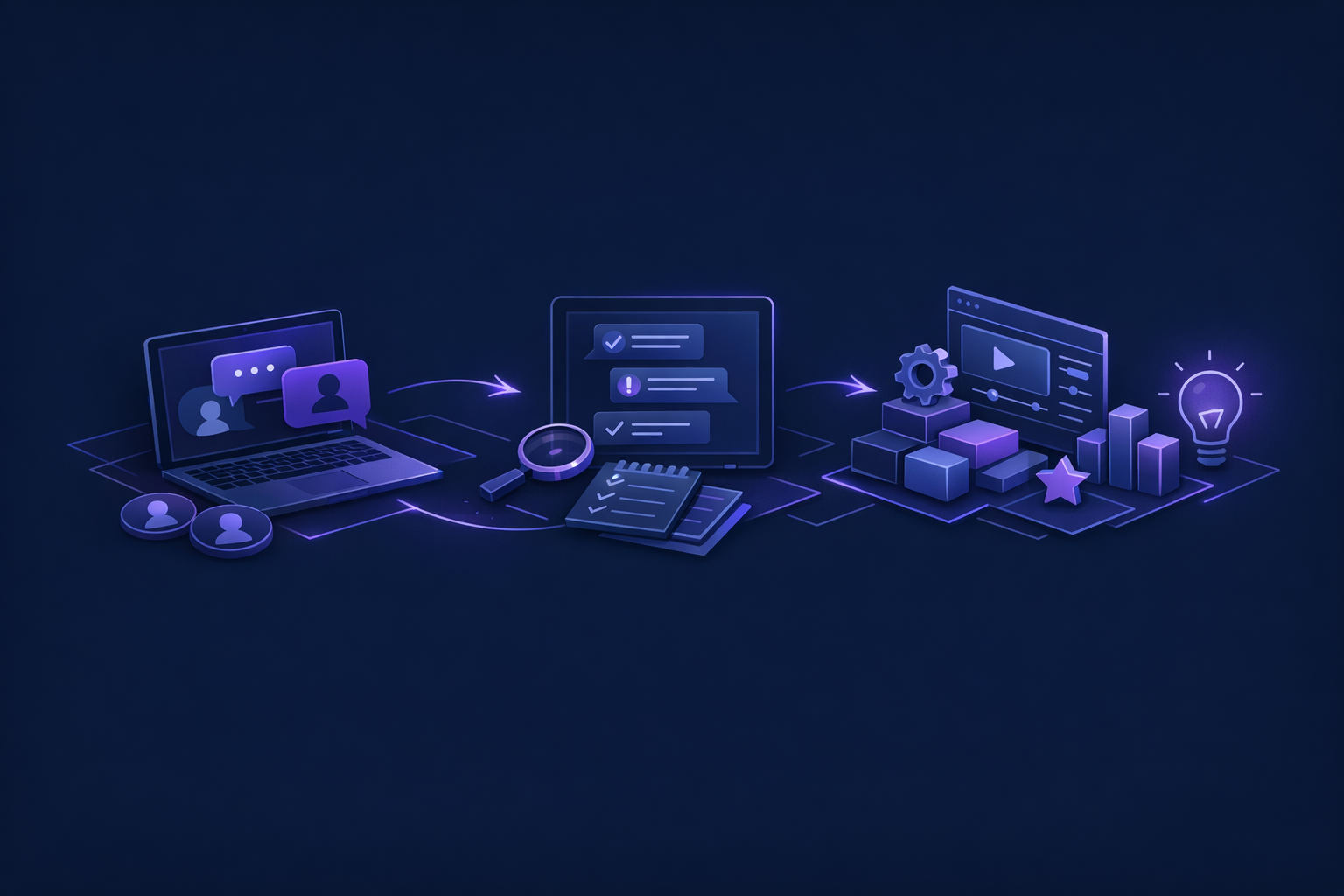
Some interview insights are required for the app to function. Others are useful because they increase confidence, trust, or conversion.
Must-have features usually include the core workflow: signup, data creation, the main action, persistence, and a result the user can see.
Confidence builders may include onboarding copy, sample data, transactional emails, billing polish, import helpers, audit trails, or a better empty state. They are not always optional. In some markets, trust is the product. But they still need to be tied to a customer objection you heard.
A practical filter is: would the user fail to complete the target workflow without this? If yes, consider it core. If no, ask whether it removes a major objection to trying or paying for the product.
The jobs-to-be-done lens is helpful here. Harvard Business Review’s article on knowing your customers’ jobs to be done is worth reading if your interview notes feel scattered.
Fit the build tier to the evidence
At Build My App Fast, we do not turn every interview set into the same kind of project. The right scope depends on how much product risk remains.
- $1,000 "Proof of concept" — proof of concept, delivered in 2–4 days. Best when the interview insight is promising but one technical or workflow assumption needs to be proven.
- $5,000 "Real app" — full app with logins and a database, delivered in 4–6 days. Best when the core workflow is clear and you need a usable product with real accounts and stored data.
- $10,000 "Launchable MVP" — advanced MVP with subscriptions, integrations, or AI features, delivered in 7–10 days. Best when interviews have validated a paid workflow and the first launch needs billing, integrations, or AI-assisted behavior.
The discipline is matching evidence to investment. If interviews only prove curiosity, a proof of concept may be enough. If interviews reveal a repeated painful workflow and buyers are waiting, a real app or launchable MVP can be the right move.
Fixed price only works when scope is clear. That is why the translation step matters so much.
Common mistakes when converting interviews into features
The first mistake is treating the loudest customer as the roadmap. A passionate prospect can be useful, but they may represent a narrow workflow. Look for patterns.
The second mistake is building nouns instead of outcomes. Dashboard, portal, AI assistant, and admin panel are nouns. They do not tell you what user behavior must change.
The third mistake is ignoring operational work. If the app depends on you manually cleaning data, approving users, sending emails, or fixing edge cases, that is part of the product system. Decide what is manual at launch and what is automated.
The fourth mistake is skipping the boring states: empty, loading, error, unauthorized, unpaid, canceled, and deleted. Customers do not describe these in interviews, but production apps need them.
The fifth mistake is letting AI-generated screens masquerade as scope. Vibe-coded prototypes can be useful for exploring an interface, but they often skip auth rules, data integrity, payments, secure file handling, and deployment readiness. A prototype is not the same as a launchable app.
The final feature brief format
Before handing anything to engineers, create a short feature brief for each must-have feature:
- Customer problem: what pain did interviews reveal?
- User role: who experiences it?
- Workflow trigger: when does the need appear?
- Desired outcome: what should be easier, faster, safer, or clearer?
- Feature behavior: what should the app do?
- Acceptance criteria: how will we know it works?
- Data needed: what records, fields, and relationships are required?
- Permissions: who can access or change it?
- Non-goals: what are we explicitly not building now?
This brief gives engineers enough detail to build without guessing. It also gives founders a way to say no without feeling arbitrary: if a feature does not map to the brief, it waits.
FAQ
Should I ask customers which features they want?
You can ask, but do not stop there. Feature requests are clues. Better questions are about the last time the problem happened, what they did instead, what it cost them, and what would make the workflow meaningfully better.
How do I know if an interview insight is strong enough to build?
Look for urgency, repeated pain, a real workaround, and a clear next action. If people only say the idea sounds interesting, keep validating. If they describe a painful process they already spend time or money on, the signal is stronger.
What if different customers ask for different features?
Group requests by underlying job. Different surface requests may point to the same workflow problem. If the underlying jobs are genuinely different, pick one segment for the MVP. A first product should feel specific, not diluted.
Should I build the feature exactly how customers described it?
Usually not. Build the outcome they need, not necessarily the interface they imagined. Customers are experts in their pain and context. Your product team is responsible for the implementation tradeoff.
From interview evidence to shipped software
Customer interviews are only valuable if they change what you build. The useful output is not a transcript or a feature wishlist. It is a focused MVP scope: the core workflow, the required features, the non-goals, and the acceptance criteria that let engineers ship without guessing.
At Build My App Fast, that is how we turn founder research into production-ready Next.js apps with real auth, databases, payments, emails, and deployment. Fixed price, fixed timeline, full code ownership, and working software before final payment only work when the scope is grounded in evidence.
If you want a production-minded team to turn customer interview evidence into a fixed-scope build, apply here.