Find Technical Cofounder or Skip One Entirely
How to find technical cofounder candidates, test fit, and know when a fixed-price MVP is the better path.
Build My App Fast · Aug 14, 2026 · 10 min read
If you are trying to find technical cofounder candidates, the fastest path is not “network harder.” It is to reduce the risk a strong engineer sees when they look at your startup: prove demand, define the first product tightly, show that you can sell, and give them a concrete role worth joining. But there is a second path founders underuse: skip the cofounder search for version one, buy a production-ready MVP on a fixed scope, keep the code, and use traction to recruit from a stronger position later.
A technical cofounder is not a generic app builder. The right person is a long-term partner who will own architecture, technical tradeoffs, hiring, infrastructure, security, and product execution. If all you need right now is a login flow, database, Stripe subscription, dashboard, and a handful of workflows, you may not need a cofounder yet. You may need a properly scoped build.
The real question before you find technical cofounder candidates

Before you search, ask one blunt question: do you need a long-term technical partner, or do you need working software?
Those are different problems.
You probably need a technical cofounder if the product itself depends on deep technical judgment: novel AI infrastructure, hard data processing, proprietary algorithms, complex compliance, developer tooling, or a platform where engineering is the main competitive advantage. In those cases, the early technical decisions may define the company.
You may not need one yet if the first version is a standard web app: accounts, roles, payments, email, CRUD workflows, admin tools, integrations, and a clean user experience. That work still has to be done well, but it does not automatically justify giving away a large ownership stake before you have customer proof.
Many non-technical founders mix up “I cannot code” with “I need a technical cofounder.” Those are not the same. If you can define the customer, sell the outcome, make product decisions, and keep the scope disciplined, you can often get to a real MVP without adding a permanent cofounder immediately. Our guide to building as a non-technical founder covers that path in more detail.
How to find technical cofounder candidates without wasting months
If you do decide to search, treat it like recruiting a business partner, not hiring a contractor. Strong technical people evaluate the founder as much as the idea. They are asking: can this person sell, focus, make decisions, understand users, and avoid chaotic scope changes?
A useful search process looks like this:
| Step | What to prepare | Why it matters |
|---|---|---|
| Demand evidence | Customer calls, waitlist, paid pilots, letters of intent, or clear niche pain | Good engineers want proof this is not just an idea |
| MVP scope | A small first version with must-have workflows only | Shows you can prioritize and ship |
| Role definition | What the cofounder owns in product, architecture, hiring, and operations | Prevents “please build my app for equity” confusion |
| Collaboration test | A small spec review, architecture discussion, or product jam | Reveals how you make decisions together |
| Equity and cash expectation | A realistic conversation with legal and tax advice | Avoids vague promises and future resentment |
| Technical diligence | How code, infrastructure, security, and data will be handled | Shows you respect production work |
Good places to meet candidates include warm introductions, founder communities, local startup events, niche technical communities, and structured platforms like Y Combinator's Co-Founder Matching. Cold outreach can work, but only if your message is specific. “I have an idea and need a CTO” is weak. “I have talked to operators in this niche, three are ready to test the workflow, and I need a technical partner to help build the first production version” is much stronger.
Your pitch should be short and concrete:
- Who the customer is
- What painful workflow you are replacing
- What proof you have that the pain is real
- What the first version must do
- Why this person’s background is relevant
- What you bring besides the idea
The last point is important. A technical cofounder is not joining because you had a thought in a notebook. They are joining because you can create market momentum they could not create alone.
Validate before you recruit
The best way to make the cofounder search easier is to validate the business before asking someone to bet months or years of their life on it.
Validation does not require a full app. You can interview users, sell a manual service, create a landing page, run a concierge workflow, or collect preorders where appropriate. The goal is to learn whether people care enough to act, not whether they compliment the concept.
If you have not done this work, start with the basics in how to validate a startup idea before you build. A technical cofounder candidate will take you more seriously if you can say, “Here is what I learned from real buyers,” instead of, “Everyone I mention it to says it sounds cool.”
This also protects you. Recruiting a cofounder too early can lock you into the wrong product, the wrong architecture, or the wrong relationship before the market has given you a clear signal.
When skipping the technical cofounder is the better move
Skipping the cofounder search does not mean avoiding engineering quality. It means buying the first build instead of trading away long-term ownership before you know what you have.
This is often the better path when:
- The MVP can be built with proven web app patterns
- You need customer demos or pilots quickly
- The business risk is larger than the technical risk
- You are still testing pricing, positioning, or workflow fit
- You want to recruit later with real traction
- You do not yet know what kind of technical leader the company needs
A fixed-scope MVP can change the recruiting conversation. Instead of asking someone to imagine the product, you can show them working software, customer behavior, and the parts of the system that need deeper technical leadership.
The key is scope discipline. If the first version turns into a giant product wishlist, you will create the same delay you were trying to avoid. Use a tight feature set and define what must be true for the app to be useful. Our MVP checklist for non-technical founders is a practical way to separate required features from nice-to-have ideas.
What a production-ready first build should include
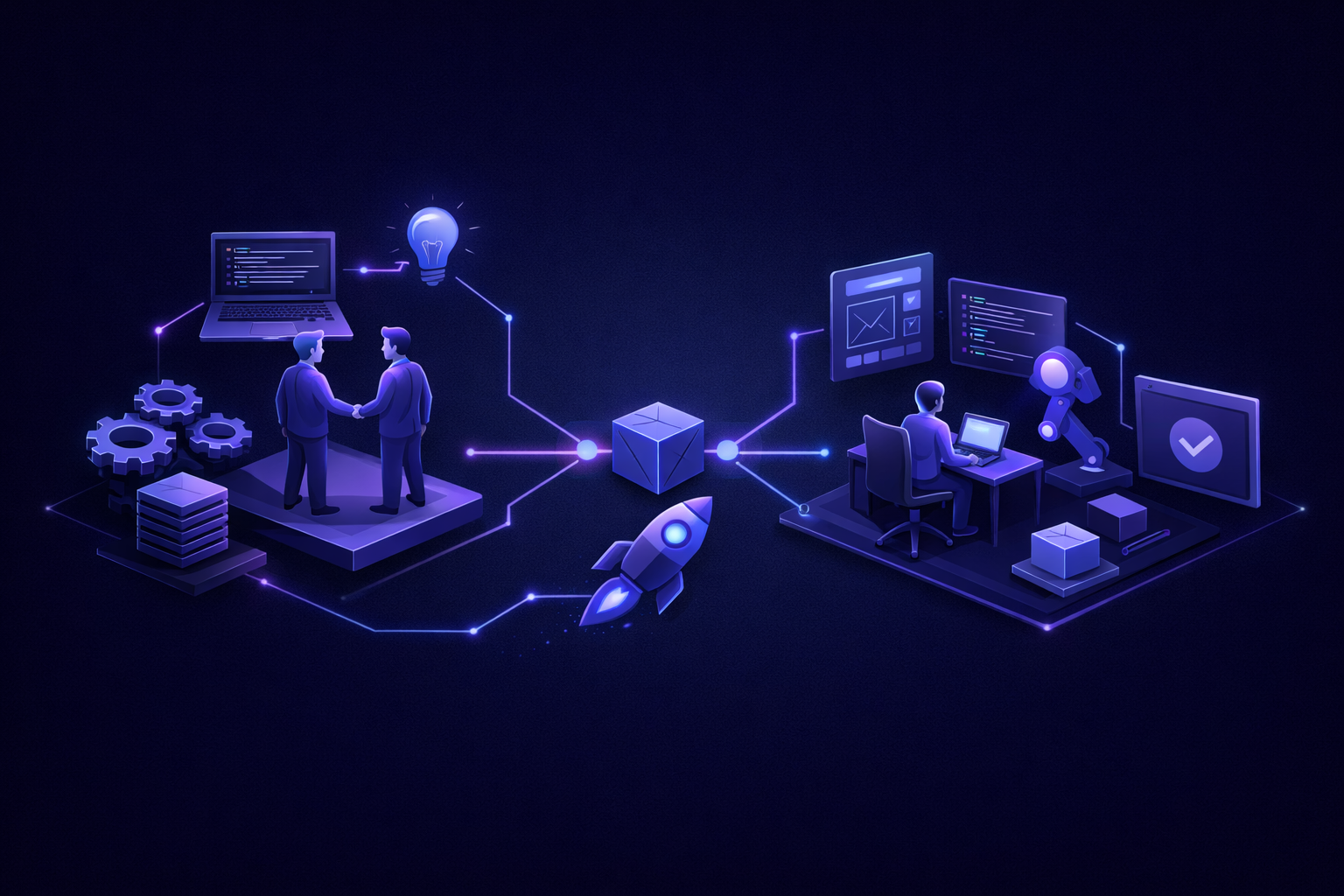
A serious MVP is not a clickable mockup. It should let real users complete the core workflow safely enough that you can learn from them.
For many SaaS products, that means:
- Authentication and user roles
- A real database with sensible data modeling
- The core workflow users came for
- Payments or subscription setup if monetization is part of the test
- Transactional email where needed
- Admin visibility into users and activity
- Error handling and deployment on stable infrastructure
- Code you own and can hand to a future technical hire
This is where pre-AI engineering judgment matters. AI tools and vibe coding can be useful for prototypes, internal experiments, and throwaway demos. They are less reliable when the app needs secure auth, payments, permissions, clean data models, environment variables, production deployment, and maintainable code.
For example, subscriptions are not just a button. Stripe has clear concepts around customers, products, prices, subscriptions, invoices, and webhooks, all documented in the official Stripe Billing docs. A production build needs those pieces wired carefully so billing state and app access do not drift apart.
The fixed-price alternative to a cofounder search
Build My App Fast exists for founders who need the first real version without pretending a fragile prototype is a company.
We build with a production stack we use repeatedly: Next.js, React, Supabase, Stripe, Tailwind, Resend, and Vercel. The point is not novelty. The point is speed with known patterns, real engineering judgment, and code that a future technical cofounder or in-house engineer can understand.
Our tiers are intentionally simple:
- $1,000 Proof of concept — proof of concept, delivered in 2–4 days
- $5,000 Real app — full app with logins and a database, delivered in 4–6 days
- $10,000 Launchable MVP — advanced MVP with subscriptions, integrations, or AI features, delivered in 7–10 days
The client gets full code ownership and sees working software before final payment. That matters because the risk in early development is often not just “can someone code it?” The risk is vague scope, moving timelines, unclear deliverables, and finding out too late that the app is not production-ready.
This is also why fixed price can be cleaner than open-ended hourly work for an MVP. If you are comparing models, read fixed price vs hourly development before you commit to a build path.
How to decide: recruit, build, or prototype
Use this decision framework.
Choose a technical cofounder search if the company’s core advantage is technical depth and you already have enough demand evidence to attract a serious partner.
Choose a fixed-price MVP if the product can be built with proven patterns and your biggest need is to get real users into a working app.
Choose a prototype if you are still unsure what the product is, who it serves, or whether the workflow matters. A prototype can be no-code, a design mockup, or a manually operated service. It should not be confused with a launchable product.
The most expensive mistake is trying to do all three at once: recruiting a cofounder, building a large app, changing the product weekly, and validating the market after the fact. Pick the next constraint. If the constraint is market clarity, validate. If it is working software, build. If it is deep technical leadership, recruit.
A good MVP scope makes every option easier. If you need help narrowing the first version, start with how to scope an MVP so it ships in under 2 weeks.
What to give a future technical cofounder if you build first
If you skip the cofounder for version one, do not create a mess for the person you hope to recruit later.
Make sure you can hand over:
- The GitHub repository
- Environment variable documentation
- Database schema and migration history where applicable
- Deployment access or transfer plan
- Notes on known tradeoffs
- Product decisions and user feedback
- A clear list of what is intentionally not built yet
This is one reason code ownership matters. A future technical cofounder should be able to review the app, understand the stack, assess the tradeoffs, and decide what to keep, refactor, or rebuild. They may still change major parts of the system later, but they are starting from evidence instead of guessing.
FAQ
Is it bad to build before I find technical cofounder candidates?
No. It is often smart if the first version is technically straightforward and your main risk is customer demand. A working MVP can make the cofounder search easier because candidates can see the product, code, users, and next technical challenges.
How much equity should I offer a technical cofounder?
There is no universal answer. It depends on stage, contribution, cash compensation, vesting, responsibility, and legal structure. Talk to a startup attorney before making promises. The important point: do not use equity as a vague substitute for a clear role, commitment, and decision-making agreement.
Can a fixed-price MVP become the long-term product?
Sometimes, yes. Sometimes it becomes the learning version that informs a larger rebuild. The goal of an MVP is not to predict every future requirement. It is to create a real product that can test the riskiest assumptions and give future engineering work a clearer direction.
Should I use vibe coding while searching for a cofounder?
Use it for throwaway prototypes, internal demos, and exploring UI ideas. Be careful using it for production systems with customer data, payments, permissions, or security-sensitive workflows. A technical cofounder will care less that AI generated code quickly and more whether the system is understandable, secure, and maintainable.
If you want to skip the cofounder search for the first version and launch with owned code, apply to Build My App Fast.